
Criminal Cases in the Outagamie County Courts
Wisconsin felony and misdemeanor prosecutions filed in Outagamie County go to the Outagamie County Circuit Court. The court has general trial jurisdiction. Its clerk holds the complaint, motions, orders, judgment, sentence, and other public filings. The District Attorney decides what state charges to file, but that office is not the public case-file custodian. Arrest reports likewise stay with the sheriff or police agency that created them.
Municipal courts handle ordinance and civil-forfeiture matters rather than Wisconsin crimes. This distinction matters in Outagamie County because Kaukauna Municipal Court says it is not a court of record and its proceedings do not appear on WCCA. A city citation can therefore exist without a circuit-court result. Confirm whether the matter is a state criminal case or a local ordinance case before treating an empty search as the final answer.
Seven Outagamie Court Branches
All seven Outagamie County Circuit Court branches sit in the county complex at 320 S. Walnut Street in Appleton. Branch numbers identify courtrooms and judges, not separate felony and misdemeanor record systems. The same Clerk of Circuit Courts serves as custodian across the branches. A branch shown on a docket tells a reader where a hearing or ruling belongs within that one county file.
The same Walnut Street complex houses the District Attorney, court commissioner, Criminal Justice Treatment Services, and jail functions. The Sheriff's report lobby is instead at Goodland Drive. Go to the clerk for complaints, orders, judgments, and court copies; use the originating agency for an incident or arrest narrative. That office split prevents a needless records stop.
The Wisconsin judiciary's circuit-court directory supplies current branch contacts. Its neutral branch listing is shown below.
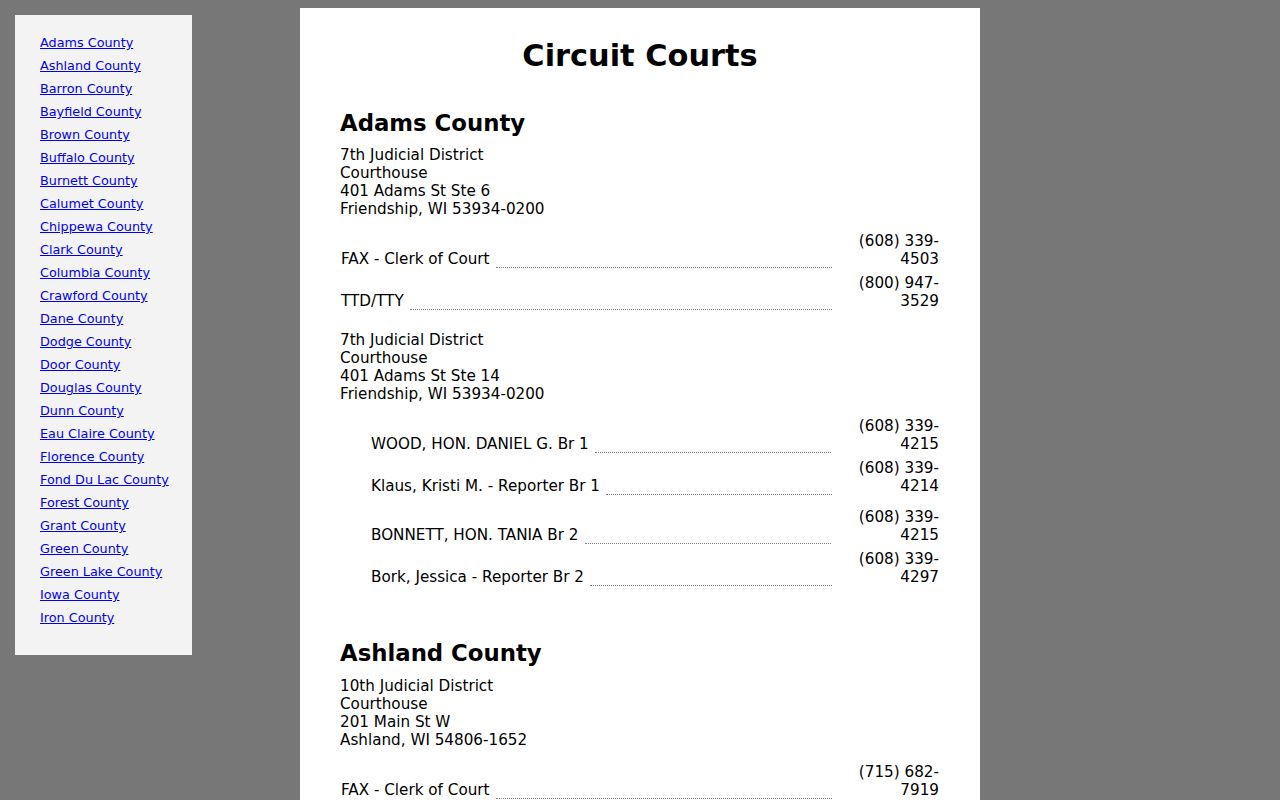
Use that directory for courtroom contact details, while record-copy questions stay with the Outagamie County clerk's records staff.
How to Search Case Records
Wisconsin Circuit Court Access, widely called WCCA or CCAP, is the free public index for Outagamie County criminal cases. It supports a party-name search, a business-name search, and a case-number search. A county filter helps avoid mixing an Outagamie County case with a same-name party elsewhere in Wisconsin. Search results are informational docket summaries, not certified copies.
- Open WCCA and choose Party Name when the case number is unknown.
- Enter the last name, then add first name, middle name, or date of birth when known.
- Select Outagamie in the County field, or use Case Number mode for a known file.
- Open the result and compare county, filing date, charges, status, and branch before relying on the match.
- Note the case number and docket item, then request the public document or certification from the clerk.
| Field Label | Type | Required | Notes |
|---|---|---|---|
| Search mode | Tabs | Yes | Party Name, Business Name, or Case Number |
| Last Name | Text | Party mode | Main party-name field |
| First / Middle Name | Text | No | Narrows a common surname |
| Date of Birth | Date | No | Display may remain masked |
| County | Dropdown | No | Choose Outagamie for county-only results |
| Case Number | Text | Case mode | Uses year, type, and sequence |
The judiciary case-search launch page provides the official route into WCCA. The captured launch interface below helps distinguish that court channel from a commercial name-search page.
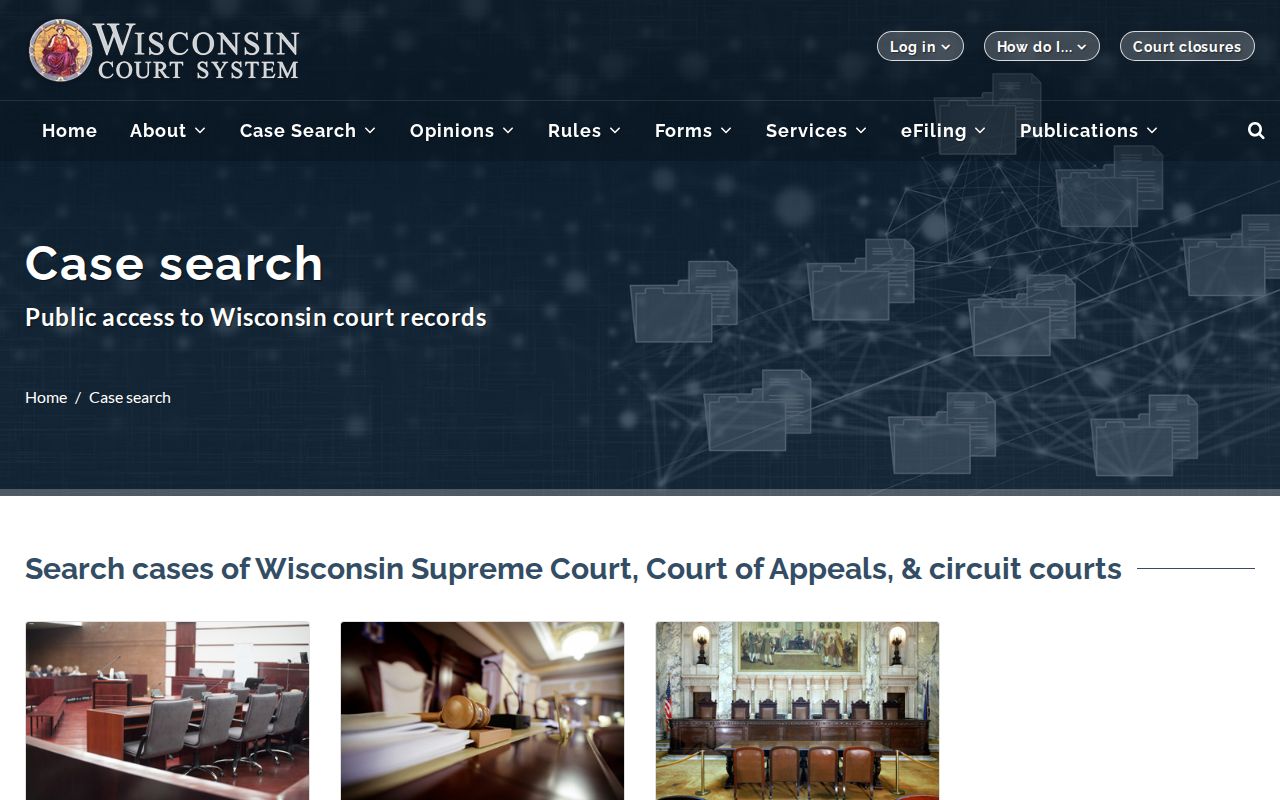
Once a case is identified, preserve its full number because the clerk can locate the underlying Outagamie County court record far more precisely with it.
Outagamie Court Copies and Certification
WCCA commonly lists a complaint or judgment as a docket event without supplying the document itself. Request the public copy from the Outagamie County Clerk of Circuit Courts. Records questions go to 920-832-5130, and fax requests go to 920-832-5115. Written requests may be mailed to 320 S. Walnut Street, Appleton, WI 54911. The clerk can email documents after payment. The researched copy price is $1.25 per page; ask the clerk whether certification adds a separate charge.
The clerk's public hours are Monday through Friday, 8:00 a.m. to 4:30 p.m., excluding county holidays. A precise request should name the case number and the docket document sought. If the number is unknown, provide the party name and enough case detail to separate likely matches. The statewide clerk directory is a second official route to verify office contact information.
That statewide clerk directory and its Outagamie County access point appear in the source image below.
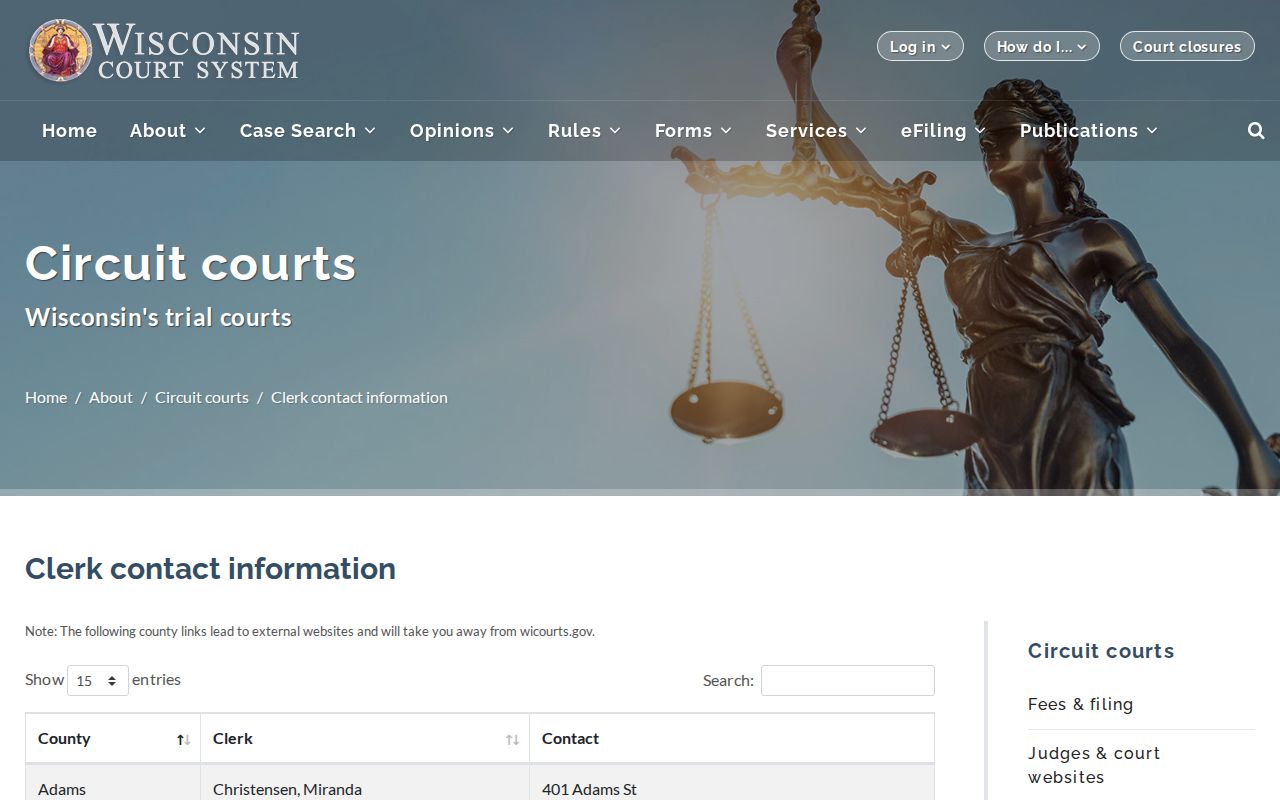
The image reinforces the key split: WCCA identifies the case, while the clerk supplies the official public filing and any requested certification.
Note: A docket description is not the complaint, order, or judgment itself; request the named document when its exact language matters.
What the Case File Shows
An Outagamie County criminal case file records the prosecution as it changes over time. Filed counts may be amended, dismissed, or resolved differently from the first allegation. Read the charge line together with its disposition and the dated docket. The public summary can also show bond activity, warrants, hearings, receivables, and the sentence, while protected personal data may be masked.
| Case Number & Court | County, filing year, case type, sequence, status, classification, and branch. |
|---|---|
| Parties | State, defendant display, prosecutor, and defense attorney when public. |
| Charges | Count, description, statute, offense date, severity, class, and disposition. |
| Docket Entries | Dated filings, hearings, pleas, orders, warrants, payments, and judgments. |
| Disposition & Judgment | The result of each count, such as conviction, dismissal, or acquittal. |
| Sentence & Finances | Confinement, probation or supervision, concurrent or consecutive terms, obligations, and displayed balance. |
A full birth date, address, juvenile matter, sealed case, or other confidential record may be absent from the public view. An absence can reflect access rules rather than a system error.
Read Outagamie Case Outcomes
Three labels often get blurred: charge, amended charge, and disposition. The charge states what was filed. An amended charge records a later change. The disposition states how that count ended. A reader should never quote only the original count when the same Outagamie County docket shows a dismissal, acquittal, or conviction on a different count.
- Arraignment
- The hearing where the charge is formally addressed and a plea is entered.
- Disposition
- The outcome of a charge, such as conviction, dismissal, or acquittal.
- Docket
- The dated list of filings, hearings, orders, and other case events.
- Concurrent
- Sentences served at the same time to the extent the judge orders.
- Consecutive
- Sentences served one after another.
CF, CM, and CT appear in Wisconsin case numbers as type markers used with the filing year and sequence. The docket itself provides the classification and filed charge details. Do not guess an outcome from the code alone. If an arrest is the starting point, the separate Outagamie County arrest history explains why booking allegations can differ from later court counts.
Stages of a Criminal Case
The Outagamie County court file begins when a charging document is filed, not merely when an arrest happens. The docket then adds appearances, bond decisions, motions, pleas, hearings, trial events, rulings, and judgment as they occur. Some cases end before trial. Others resolve through a plea or verdict. The order below is a reading aid, not a promise that every case will contain each event.
Case flow: Charges Filed › Arraignment › Pretrial › Plea or Trial › Disposition › Sentencing
After sentencing, the Outagamie County file may continue with payment entries, post-conviction motions, supervision-related filings, or an expungement event when the law and original sentence permit it. The clerk's chronology is therefore more useful than a single status label.
Outagamie Treatment Court Paths
Outagamie County operates Drug and Alcohol Treatment Court, Mental Health Court, and Veterans Treatment Court through Criminal Justice Treatment Services. These programs combine court supervision, accountability, and treatment. Depending on the case posture, participation may affect custody, revocation risk, or a charge outcome, but admission and results are never automatic.
A WCCA docket may reflect hearings, orders, or later outcomes connected to one of these paths without explaining the full clinical work behind it. Read the public court events and then use the official program material for eligibility and referral context. Avoid assuming that a program mention proves completion or predicts a sentence.
Outagamie Clerk Certifies Court Records
The official Outagamie County case file and the WCCA summary serve different purposes. WCCA is fast and free for locating a case. The clerk controls the original public documents and can answer a certification request. A printout of the online summary should not be described as a certified complaint, judgment, or sentence.
Wisconsin also provides Form CR-266 for a narrow expungement circumstance in which expungement was ordered and no probation or incarceration was imposed. Its official form page is pictured below.
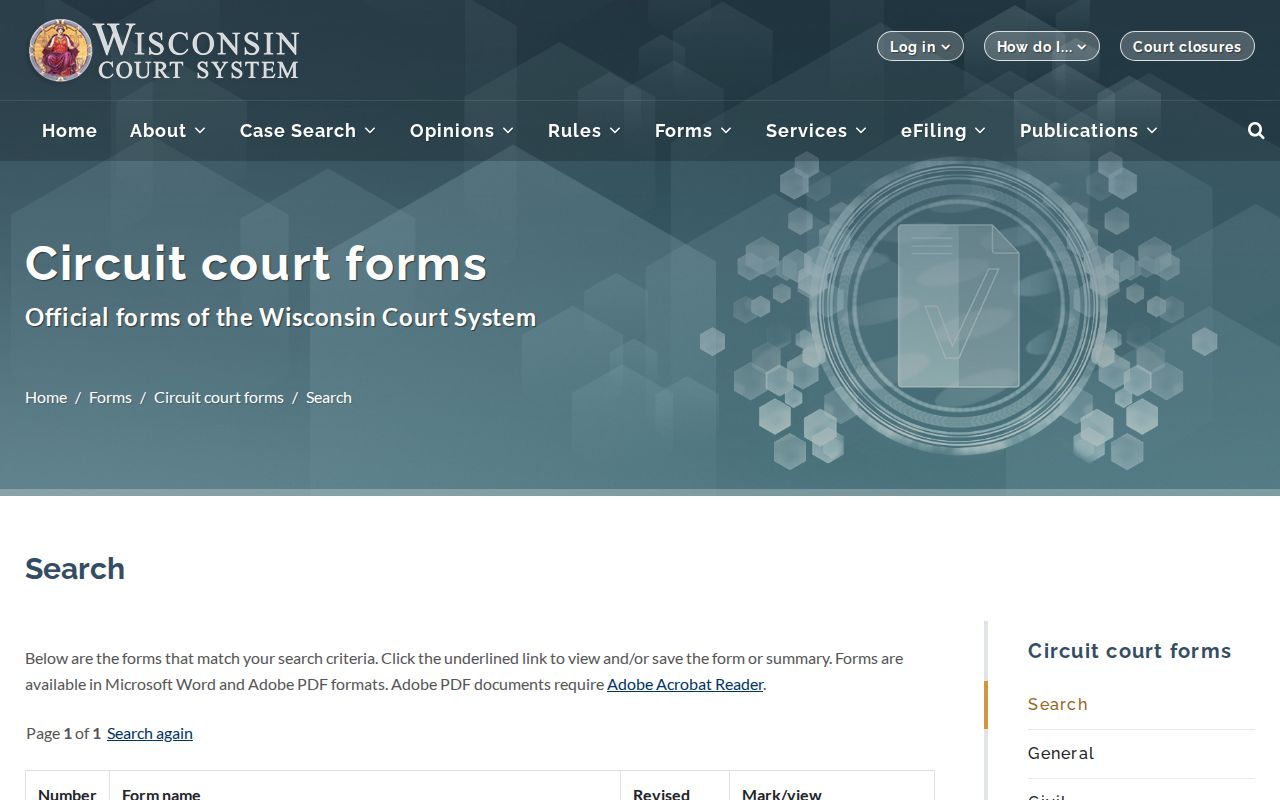
The form does not create eligibility by itself. Wisconsin expungement is limited, and the sentencing order and statutory conditions control whether an Outagamie County record can follow that route.
Access & Restrictions
The Wisconsin Public Records Law favors inspection and copying, but court access remains subject to specific confidentiality rules, sealing orders, redaction, and a balancing analysis where applicable. Juvenile cases are not ordinary adult WCCA files. Victim data, medical information, account numbers, full birth dates, addresses, and other protected identifiers may be withheld or masked.
If an Outagamie County case does not appear online, contact the clerk with the known name, date range, case type, or number. Ask whether the record is older, confidential, sealed, expunged, or simply unavailable through the public index. The clerk cannot release material barred by law, but it can explain the proper public access route. For a municipal forfeiture, contact the issuing municipal court instead.
Note: A missing public result does not prove that no case, municipal matter, confidential file, or older record exists.